




How Many CFM Should a Range Hood Have?
Author: James Zhao, Sr. Tech Specialist & Alex Park, Product Specialist
When choosing a range hood for your kitchen, it’s crucial to get a model with the right amount of suction (CFM) for your cooking space. Cooking byproducts like steam, grease, and fumes can build up in your kitchen, cling to surfaces, and affect your respiratory health.
A properly-sized range hood helps ventilate your kitchen air by removing grease, heat, odors, and harmful fumes from your kitchen in one of two ways:
1. Venting the tainted air outside
2. Scrubbing and recirculating cleaned air back into your home
This ventilation process helps your kitchen stay clean for longer, makes cooking more enjoyable, and—most importantly—keeps the air in your home fresh and clean. To clean your kitchen’s air efficiently, your range hood must have the appropriate CFM for your space, which measures how much air the hood can move.
The guide below will help you determine the right range hood for your space. In most kitchens, the decision doesn’t have to be complicated —once your cooktop, layout, and cooking style are clear, choosing the right airflow becomes much more straightforward.
What is CFM for a Range Hood?
Every range hood’s ventilation ability is measured in cubic feet per minute (CFM). The CFM measurement refers to how many cubic feet of air your range hood is capable of moving per minute at its highest speed.
Essentially, CFM indicates how quickly a range hood will vent air from your kitchen. The higher the CFM, the faster the ventilation rate.
Potential Problems of Overpowered Range Hoods
While it may seem like more power is always better, a range hood with too much CFM for your kitchen can cause issues that outweigh the benefits:
- Unnecessary energy use: A high-CFM hood running at full power consumes more electricity than needed, driving up your utility bills.
- Backdrafting: Overpowered hoods can pull air from vents or chimneys, drawing harmful gases like carbon monoxide back into your home.
- Negative air pressure: Excess suction can affect your HVAC system, making it harder to regulate temperature and air balance indoors.
- Increased noise levels: High-powered fans often run louder, creating a disruptive cooking environment.
- Ductwork complications: Smaller or improperly installed duct systems may struggle to handle the airflow, reducing efficiency and causing wear on the motor.

When Is Make-Up Air Required?
When a range hood removes air from your kitchen, that air must be replaced to maintain balanced indoor pressure. This replacement air is known as make-up air.
In many areas, local building codes require a make-up air system when a range hood exceeds 400 CFM. These systems bring fresh outdoor air into the home to offset exhausted air, helping prevent backdrafting, HVAC performance issues, and pressure imbalance.
Because requirements vary by location, it’s important to check local building codes or consult a contractor before installing a high-CFM range hood, as a make-up air system can affect installation complexity and overall cost.
Factors that Determine a Good Range Hood CFM
Most kitchens don’t need extreme airflow. When buying a range hood, your cooktop type, kitchen layout, and how often you cook will determine most of your CFM needs. When in doubt, it’s better to slightly oversize your range hood than choose one that struggles to keep up.
Below is a detailed list of the factors to consider when choosing the best range hood for your home.
1. Width & BTUs of Your Stove or Cooktop
Your cooktop’s size and heat output are two of the most important factors in determining how much airflow your range hood needs.
Wider cooktops create a larger area of smoke and grease, while higher BTU output generates more heat and fumes that require stronger ventilation—especially with gas ranges.
Together, these factors provide a baseline for CFM recommendations for range hoods. From there, airflow can be adjusted based on kitchen size, layout, ductwork, and how often you cook.
2. Ductwork Length & Design
The design of your ductwork directly impacts how effectively your range hood can move air. Long duct runs, narrow ducts, and multiple bends increase resistance, reducing airflow and overall performance.
Kitchens with more complex ducting often benefit from higher CFM to compensate for this added resistance and maintain effective ventilation.
3. Kitchen Size
Kitchen size affects how much airflow your range hood needs to keep the air clean and comfortable. Larger kitchens—or spaces with high ceilings or open layouts—require more ventilation to effectively remove smoke, heat, and odors.
As a general guideline, a range hood should be capable of refreshing the air in your kitchen about 15 times per hour. Larger or more open spaces may benefit from higher airflow.
4. Cooking Habits
How often and how intensely you cook determine how much airflow your range hood needs. Daily cooking, high-heat techniques, or preparing meals for larger groups typically require higher CFM to keep smoke and grease under control.
If you’re choosing between two range hood models with different airflow options—such as the Slant Vent Series—it’s usually better to select the higher CFM if you cook frequently.
5. Noise Level
For many range hoods, “quiet” usually means there’s a smaller fan that will produce less suction. At FOTILE, we solve this problem using physics. By utilizing the Coanda Effect, we can increase the airflow and suction of our range hoods without increasing noise levels.
6. Range Hood Mounting Height
The distance between your cooktop and your range hood affects how much airflow is needed to effectively capture heat, smoke, and fumes. As installation height increases, ventilation becomes less efficient without additional airflow.
Range hoods installed more than three feet above the cooking surface may require higher CFM to maintain proper performance.
7. Your Budget
Where your range hood is installed also affects how much airflow is needed for effective ventilation.
Island range hoods typically require more CFM than wall-mounted models because they lack a wall to help contain and direct smoke, grease, and heat. Because air can disperse in all directions, island installations often require an additional 100–200 CFM to achieve comparable performance.
If your range hood will be installed over a kitchen island, choosing a slightly higher CFM can help ensure consistent capture of cooking byproducts.
8. Your Budget
Range hoods can cost anywhere from $500 to more than $3,000. Lower-priced range hoods may be made of less durable materials and won’t vent efficiently, while extremely expensive models often have unnecessary features or are designed to fit a specific aesthetic. Avoiding the cheapest or most expensive model for something in between is generally best.
At FOTILE, our range hoods are durable, efficient, and priced to reflect that, starting at $849 for our Pixie Air UQS3001 model.
CFM Guidelines by Cooktop Type
The type of cooktop you have determines which airflow guideline is most relevant for your kitchen.
Gas ranges:
Ventilation is typically based on total heat output. A common guideline is 1 CFM for every 100 BTUs of total burner capacity.
Electric and induction cooktops: Airflow is usually based on cooktop width rather than heat output. For these cooktops, a general guideline is 100 CFM per linear foot for wall-mounted range hoods.
These guidelines assume the range hood is installed 30–36 inches above the cooking surface, which is standard for most residential kitchens.
How to Calculate CFM For Your Range Hood
To calculate the right CFM for your range hood, consider your cooktop, your kitchen’s size, and how you cook. Use the calculation below that best matches your cooktop and kitchen layout, then select the highest applicable CFM to ensure effective ventilation.
- Measure your cooktop width. Use 100 CFM for every 12 inches of stove width. For example, a 36-inch cooktop needs at least 300 CFM.
- Account for based on heat output (gas ranges only). Add 100 CFM for every 10,000 BTUs. A stove with 30,000 BTUs would require 300 CFM.
- Calculate based on kitchen volume. Multiply your kitchen’s length × width × height to get its cubic feet. Multiply that number by 15 (air changes per hour), then divide by 60.
Example:
12 ft x 15 ft x 10 ft = 1,800 cubic feet
1,800 × 15 = 27,000
27,000 ÷ 60 = 450 CFM - Use the highest result. Compare your cooktop-based and kitchen-based calculations and choose the higher number for effective ventilation.
For most households, aiming slightly higher is better—especially if your ductwork is long or you cook frequently. FOTILE’s range hoods feature high CFM to align with various kitchen sizes and needs.

Why FOTILE Range Hoods Use Max Equivalent CFM Instead
At FOTILE, efficiency and convenience are key components of high-quality range hoods. That’s why all of our range hoods have a higher CFM rating—to help make your kitchen as healthy and comfortable a space as possible.
Our filter-free technology combines WhisPower motors and our Capture-Shield design to quietly and powerfully accelerate smoke extraction and grease separation. The motors are quiet and efficient, while the Capture-Shield allows us to apply the Coanda Effect—the natural tendency of warm air to drift toward and flow along nearby surfaces, depositing airborne particles on those surfaces as it moves.
Together, these features allow our range hoods to cover larger cooktop surfaces and achieve extremely high oil filtration and odor elimination rates.
Quick CFM Tips to Avoid Common Mistakes
- It’s better to slightly oversize your range hood than choose one that’s underpowered for your kitchen.
- Higher-CFM hoods are more flexible because they can run at lower speeds when full power isn’t needed.
- Multi-speed range hoods allow you to adjust airflow based on what you’re cooking.
- Island hoods generally require more CFM than wall-mounted designs.
- If your hood exceeds 400 CFM, check whether a make-up air system is required in your area.
Choosing Your FOTILE Range Hood
FOTILE offers three styles of range hoods with various CFM capabilities to accommodate kitchens of all sizes.
Pixie Air Series – Best For Small to Medium Kitchens
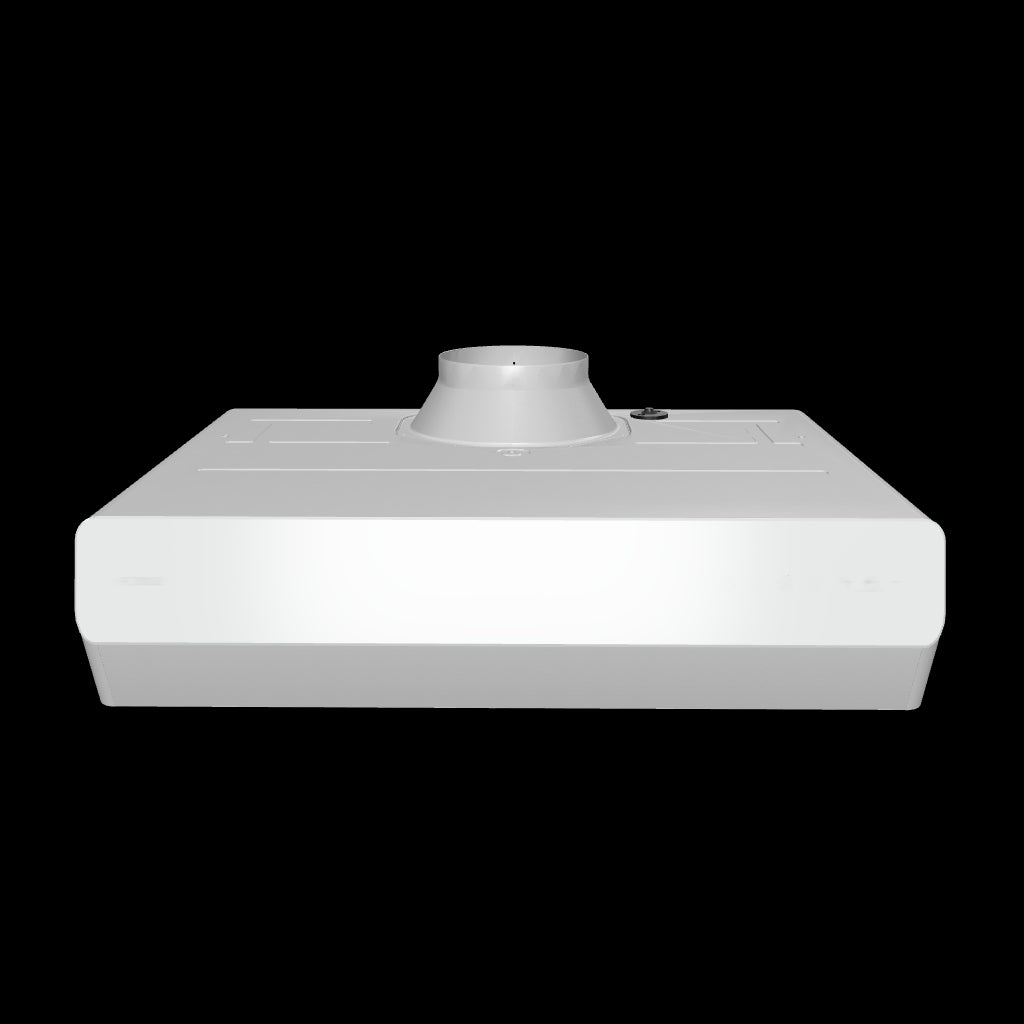
Our Pixie Air Series ranges from 800 to 850 CFM, perfect for small or medium kitchens. It mounts easily under your cabinets and comes with a recirculation kit. This kit allows you to install your Pixie Air with outside ventilation or as a recirculating range hood.
Slant Vent Series – Best For Medium to Large & Open Kitchens
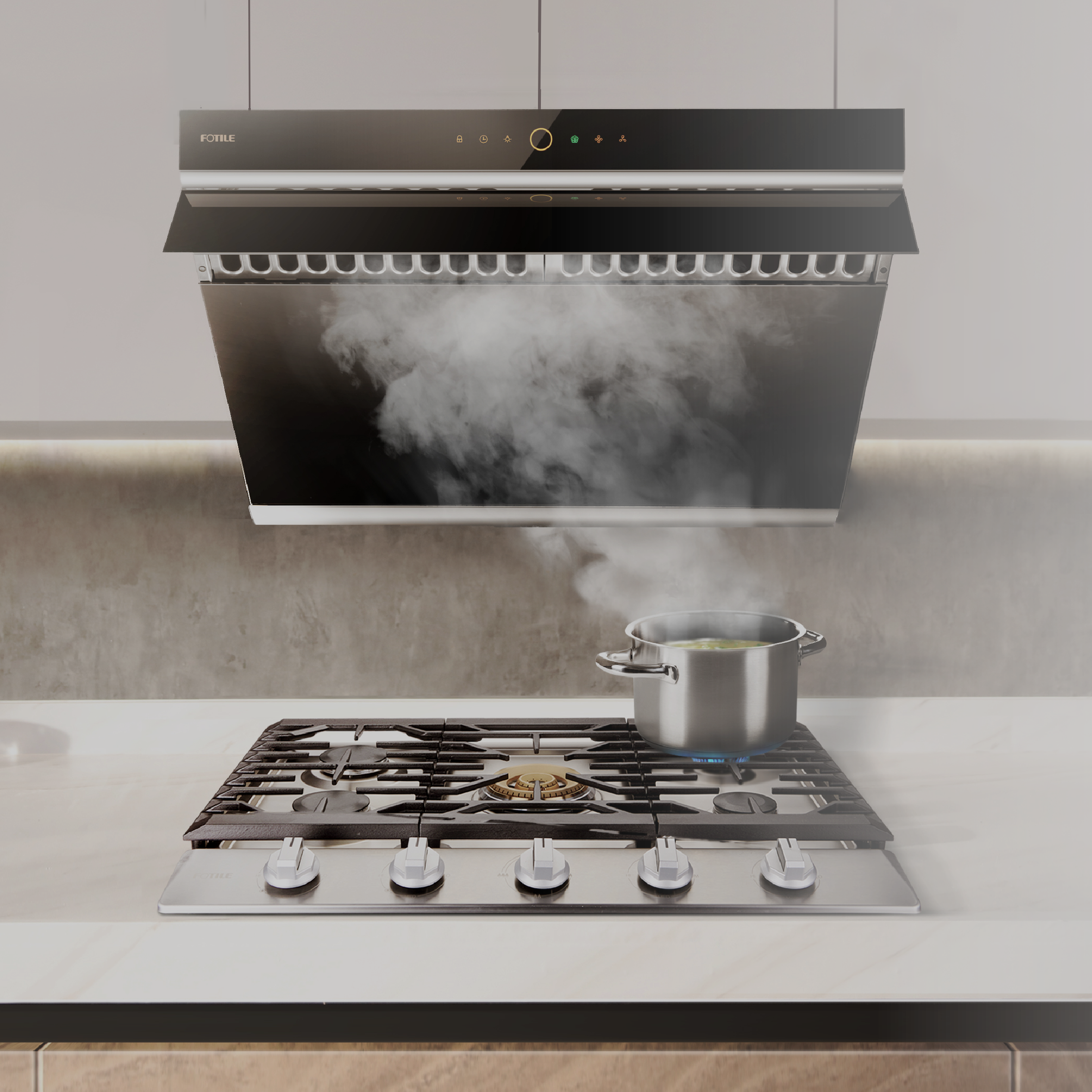
Our Slant Vent Series features between 850 and 1000 CFM for slightly larger kitchens. It works well in medium-to-large kitchens and open spaces. Like the Pixie Air, it mounts easily under cabinets and is compatible with external ventilation systems. This model also comes in brushed stainless steel or black tempered glass to accommodate your personal style.
Slant Vent Series – Best For Medium to Large & Open Kitchens
The Perimeter Vent Series features our most powerful range hoods with 1000 to 1100 CFM. All Perimeter Vent models are wall-mounted, making them ideal for large, open kitchens.

Our range hoods are guaranteed to make your kitchen safer and more comfortable for the whole family. All of our range hoods are quiet, wipe clean easily, and feature at least a 92% grease separation rate and 97% odor elimination rate. Shop now.
Frequently Asked Questions About Range Hood CFM
- Choosing a selection results in a full page refresh.
